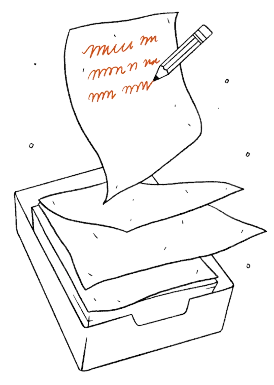


Can an origami creation remove a battery from your stomach?
#10 News Story of 2018

Share
January 29, 2018
#10 News Story of 2018
Share
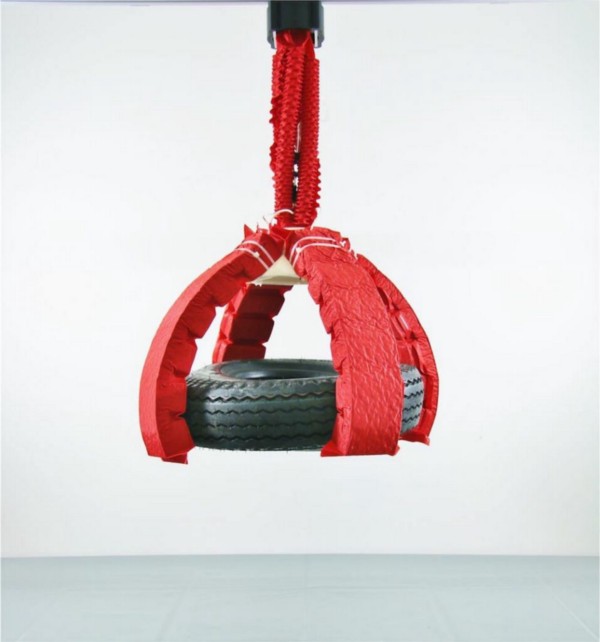
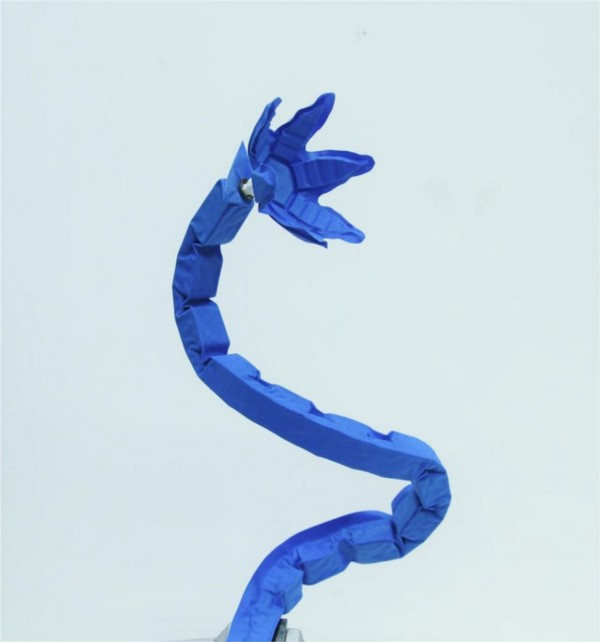
Left: This is a demonstration of strength of the artificial muscle. Right: This is a snake-like robotic arm with a flower-like gripper driven by a single vacuum source. Credit: Shuguang Li
Just as origami can transform a piece of paper into a three-dimensional work of art, scientists have now used the techniques to transform thin, flimsy materials like polyester into incredibly strong artificial muscles that can lift a thousand times their weight.
The research team built the muscles by inserting origami-like folding skeletons into flexible plastic, nylon or polyester skins filled with water or air. Then, by sucking the air or water out of them, the researchers were able to make the artificial muscles contract and grab things — just like real muscles due to the movements “programmed” into the devices’ folding skeletons. They describe their findings in the Proceedings of the National Academy of Sciences.
“One thing I’m interested in is making machines that are like ‘Transformers,’” says study author Daniela Rus of Massachusetts Institute of Technology. “Machines that can change their body to match their body to the task they need to do.” In this interview, she discusses her latest work, along with other projects like an ingestible robotic pill that unfolds in the stomach.
Questions
“But in nature, things happen in much more elegant ways. And in particular, folding in nature occurs to create a wide spectrum of complex structures, morphofunctional structures.” — Daniela Rus
“Robots are made of bodies and of brains that control the bodies.” — Daniela Rus
Activity Suggestions
Additional Resources
Vocabulary: robot, origami, morphofunctional, muscle, operations
Next Generation Science Standards: ETS1.A: Defining and Delimiting an Engineering Problem, ETS2.A: Interdependence of Science, Engineering, and Technology, SEP2: Developing and Using Models, CCC6: Structure and Function. Can be used to build towards MS-PS2–1, MS-ETS1–1, MS-ETS1–2, HS-PS2–3, and HS-ETS1–2.
Common Core State Standards: CCSS.ELA-LITERACY.RST.6–8.1, CCSS.ELA-LITERACY.RST.9–10.1, CCSS.ELA-LITERACY.RST.11–12.1
Xochitl Garcia @msxgarcia -Education program assistant @scifri and 2015 #grosvenorteacherfellow @NatGeoEducation. #STEM Educator obsessed with food and board games.
Science Friday Spoonfuls @scifri - The latest and greatest science news from public radio’s Science Friday, ready for classroom use.