


What Would Happen If Every Student Had an IEP?
Discover how applying IEP principles to every student could transform learning, personalize instruction, and create more equitable, student-centered schools.

Share
December 5, 2025
Discover how applying IEP principles to every student could transform learning, personalize instruction, and create more equitable, student-centered schools.
Share
Note: This blog is part of a three-part series. Be sure to check out the companion pieces here and here.
Most educators and families would agree that the state of public education is, at best, compromised by conflicting interests and ideals, and at worst, a relic of industrialization that is no longer applicable. Don’t get me wrong. There are pockets of amazing programming that allow students to truly be their best selves, like Newburgh Free Academy for CTE, these top-performing STEM high schools and Booker T. Washington High School for performing arts, to name a few. However, all too often, there are barriers to creating learning environments and opportunities that will best serve all students. Yet, as we celebrate the 50th anniversary of IDEA (the Individuals with Disabilities Education Act), originally the Education for All Handicapped Children Act, I think we could revolutionize education by leveraging the data available to us with the tenets of “special education.” Hear me out.
So, here’s what I can know about my students in a relatively short period of time, all from the learning management system, with regular old teacher-level access: socioeconomic status, family makeup, employment of parents, statistical information, behavior records, attendance records and a multitude of data points from standardized testing and benchmarks that can pinpoint a student’s strengths and weaknesses in reading, writing and math. Armed with all of this information, I can then create a profile of each student, which can in turn be used to develop an individualized education plan for all students, not just those who are protected by IDEA. Even a generic education plan—in this case, what was created by ChatGPT, is preferable to the way scheduling and grouping is done now. Here’s an example that kind of blew my mind.
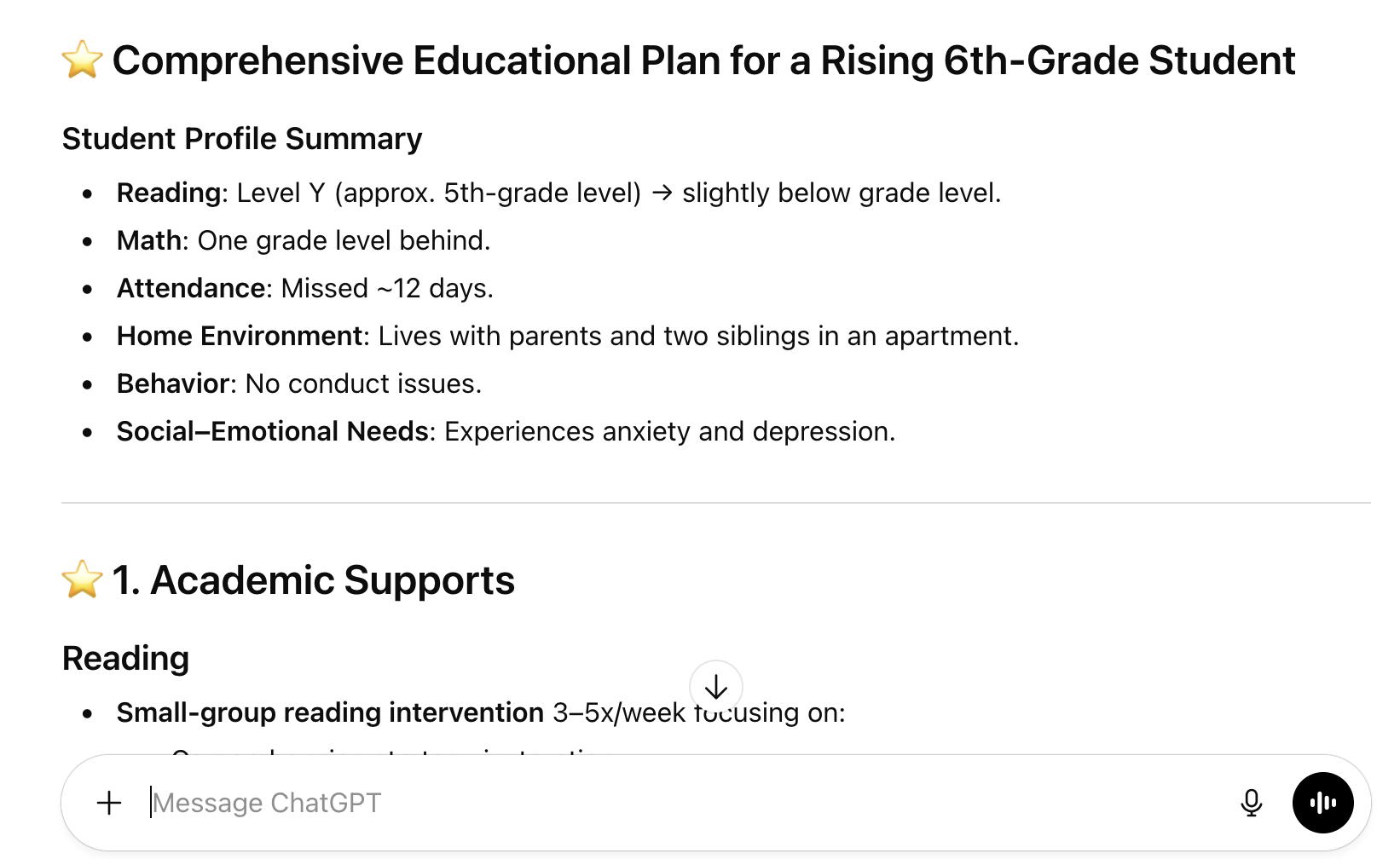
After experimenting with the data of the above fictional student, I decided I had to see what ChatGPT would come up with for a student I know very well, my son. I’m not going to share the plan here, but I highly recommend that you try this experiment yourself, either using your own child or a student you know well. Suffice it to say, if ChatGPT can come up with a plan that would have highly benefited my child, we can leverage information to come up with profiles of certain types of students, and then we can offer common supports to them. Add with personalized surveys for students and families, like this one I use each year, it is possible to create an IEP for every student.
Now, before you come at me for diminishing the very important aspects of special education that involve modifications and accommodations, please know that I’m not looking to minimize their value but instead offering a broader perspective. With our current access to information and some flexibility, all education could be differentiated to help students learn best. IDEA guarantees a free appropriate public education (FAPE), ensures students are educated in the least restrictive environment and requires collaboration with families and students. Let’s take a look at how these could be applied to all students.
The pertinent word here is “appropriate.” When considering the educational pathways for students, we can use the kind of data described above to figure out the most appropriate educational configuration or programming. Even though it was way back in the 1900s, when I was a student I didn’t really do much in the fourth and fifth grades because my reading and writing were so advanced, and my math so low, that I actually spent my day shuffling between volunteering with younger kiddos in the library, pushing into middle school ELA classes, learning to file and type in the main office, and visiting a trailer behind the school for double blocks of math interventions. Mind you, it was the early 1980s, and these were impressive attempts to do what was best for me, not the status quo. I would not be a teacher had I sat in my fourth-grade classroom in reading groups that made absolutely no sense for me to be in, and I never would have survived middle school math without some steep investments in improving my skills. Was this perfect? No. Is it scalable? Not exactly. But I do know that the talent I had for reading and writing was appreciated and utilized instead of being treated like a problem, as often happens with exceptionalities on either end of the spectrum. We can create all kinds of opportunities for students to serve their schools and communities, which will keep students invested, if only we are free to make decisions that are truly best for the kiddos.
If we begin to approach all students with an eye toward creative programming and scheduling, we can see the benefits.
This article from the National Association of Gifted Children sheds light on some of the myths and misconceptions around gifted students, and it is quickly evident that the “one size fits all” approach doesn’t work well with this subgroup either. This article from Kids Included Together dispels myths about students with learning disabilities. I’m juxtaposing these two articles to demonstrate how wrong we can be about what is best for students, even within the more studied groups of children. If we begin to approach all students with an eye toward creative programming and scheduling, we can see the benefits. When taken together, and what I’m sure you already know in the classroom, we need to incorporate more data into decision-making and get creative with the solutions.
Too often, we hold kiddos back. Just because a student is incredibly behind in one area does not mean that they will not thrive in other areas. If I had been categorized simply by my math deficits, I would have never realized a great number of successes. There is tremendous pressure to “catch kids up,” but there are some scenarios where we need to allow students more freedom to expand their learning and thinking without requiring them to have mastery. What is so wrong with allowing students to expand their learning, even if they are only approaching proficiency? This is a long-held conversation regarding AP classes, one taken up with Stanford here. The fact is, if you haven’t figured it out in the midst of all these pseudo educationally sound decisions, education has become a business, and too many decisions are based on factors that are not student-centered.
Sometimes, the students themselves are completely left out of these conversations about what would work for them. The Brookings Institute’s article, “Prioritizing Student Voice in Education System Decision Making and Transformation,” takes a global perspective and looks at the generational impact of educational decisions. If your head is spinning, so was mine. What data should be determining if students receive special education services? The National Center for Education Statistics paints an equally blurry picture, with 15 percent of all students being “classified” and receiving special education services. Just like AP classes, there is no parity in terms of who gets what services, and the outcome is often a mismatch of children with what they need. Of all the data points, perhaps the most important is the one that is most often left to chance: the input from the people who know their children best.
IDEA turning 50 gave me a chance to consider the impact it has on schools and learning. Within that research, things got more and more muddy. There is no doubt that IDEA is essential, relevant and of utmost importance in creating equitable learning. However, given all of the easily accessible data points, paired with student and family surveys and rounded out with teacher observations, we could create an individualized education plan for each student. We could then group students according to needs that are articulated with their profile. It’s been a decade since I wrote my first book, The Flexible ELA Classroom. In it, I argued for options and choice with a generous helping of flexibility to teach the students in front of you—not the ones you wish you had or the ones that another teacher tells you about. I believed—and still do—that it is our obligation to do all we can to make sure all students are learning, whatever it takes. IDEA gave us that framework for students with disabilities, but we can use it for all students.
And if you want to experiment with leveling texts with Share My Lesson resources, click on “EdBrAIn It” to change the grade level and create a variety of leveled activities.
In this collection, you will find resources to help students better understand different disabilities, promote inclusion, challenge ableism, and make accommodations for others.
Empower your teaching with effective strategies and tools designed to support the whole student. This collection features insightful webinars and blogs covering student well-being, creating positive school environments, and fostering inclusive classrooms.